

Topkapı Palace

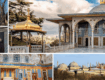
Topkapı Palace
Topkapı Palace was commissioned by Sultan Mehmed II (Mehmed the Conqueror) following the conquest of Constantinople and was constructed between 1460 and 1478. The palace reached its current form through additions made by successive sultans. Initially built in the Sarayburnu area, which was once known as an olive grove, the construction began with garden arrangements and pavilions, and continued with the building of the palace walls known as Sûr-ı Sultânî (or Kal‘a-i Sultânî). Due to the existence of the Old Palace in Beyazıt at the time, the new complex was initially referred to as Sarây-ı Cedîd-i Âmire (The New Imperial Palace). Later, the name “Topkapı Palace” became common, derived from a pavilion known as “Toplu Kapı.” With various expansions over time, the palace continued to serve as the administrative and residential center of the empire until the mid-19th century. As Topkapı Palace no longer met the needs of 19th-century state protocol, Dolmabahçe Palace was built between 1843 and 1856, and eventually became the new imperial residence and administrative center.
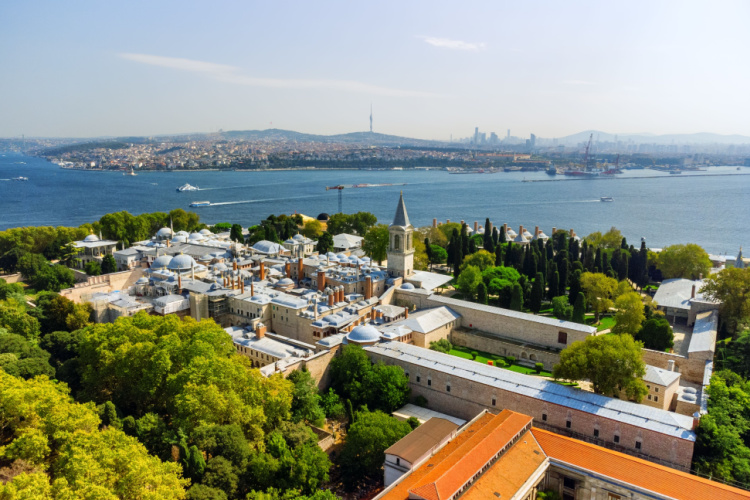
Topkapı Palace is located in one of the oldest historical districts of Istanbul, on the Historical Peninsula between the Sea of Marmara, the Bosphorus, and the Golden Horn. Situated on the former acropolis of Eastern Roman Byzantium in Sarayburnu, the palace occupies an area of approximately 700,000 square meters. For nearly four centuries, until the reign of Sultan Abdülmecid—the 31st Ottoman sultan—it served as the administrative, educational, and artistic hub of the empire, as well as the primary royal residence. Although the imperial family relocated to Dolmabahçe Palace in the mid-19th century, Topkapı Palace retained its historical significance.
Following the foundation of the Republic of Turkey, Topkapı Palace was converted into a museum on April 3, 1924, becoming the first museum of the Republic. Today, excluding Gülhane Park, it covers approximately 350,000 square meters. With its architectural structures, collections, and roughly 300,000 archival documents, it stands as one of the world’s largest palace-museums.
The palace’s layout is composed of large courtyards surrounded by arcades and service buildings, with a design inspired by the Edirne Palace. The service buildings are primarily single-story structures made of stone with high domes, while residential sections are built with a combination of stone and wood, featuring lead-covered domes. The palace interiors and gardens are enriched with fountains, pools, cisterns, and other ornamental water features.
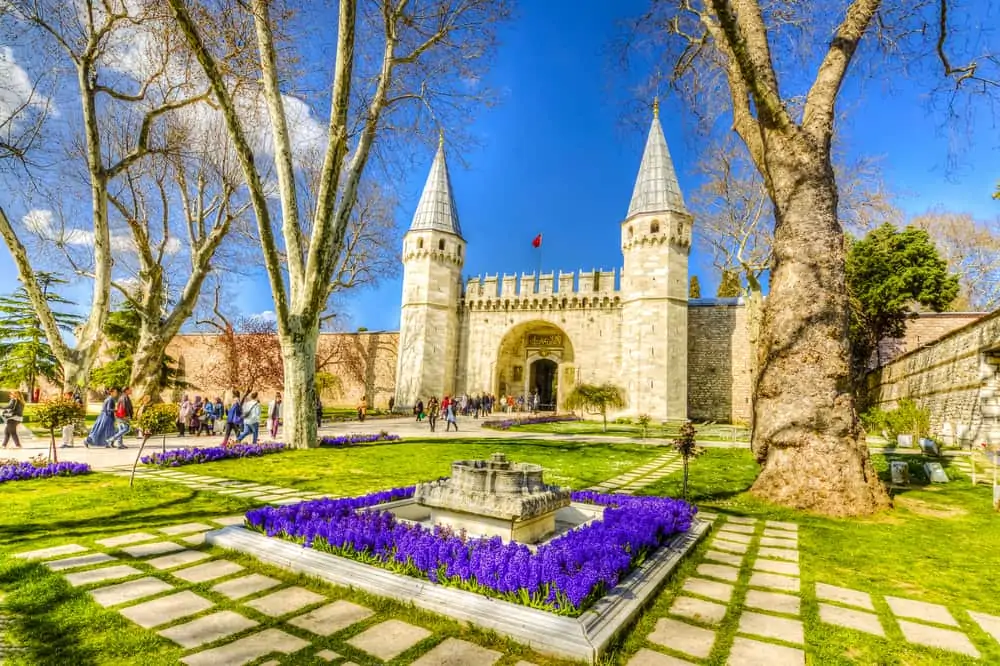
Topkapı Palace is structurally divided into four principal sections: the outer service and security area (Bîrun), the administrative center (Dîvân-ı Hümâyun), the educational quarters (Enderûn), and the private quarters of the sultan (Harem). Built alongside the old Byzantine city walls, the palace has three main gates—Bâb-ı Hümâyun (Imperial Gate), Demir Kapısı (Iron Gate), and Otluk Kapısı (Hay Gate)—as well as five service entrances known as Koltuk Kapısı. The first gate, Bâb-ı Hümâyun, is a two-story gate pavilion featuring an inscription signed by Ali b. Yahyâ es-Sûfî. The second gate is Bâbüsselâm (Gate of Salutation), and the third is Bâbüssaâde (Gate of Felicity). The palace complex comprises four interconnected courtyards surrounded by architectural structures. The first courtyard, also known as the Court of the Janissaries or the Parade Court, includes buildings such as the Hagia Irene Church, the Imperial Mint, Bakery, Hospital, Wood Depot, and Mat Weavers’ Quarters.
The second courtyard, known as the Divan Square or Square of Justice, housed the key governmental functions. It contains the Divan-ı Hümâyun (Imperial Council Chamber), also known as the Kubbealtı, where state affairs were discussed. Behind it stands the Tower of Justice, and adjacent are the entrance to the Harem, the Hall of the Halberdiers with Tresses (Zülüflü Baltacılar), and the Imperial Stables.
The third courtyard, also called the Enderûn Courtyard, includes various chambers such as the Audience Chamber (Arz Odası), the Falconers’ Quarters, the Wardrobe and Pantry Chambers, the Inner Treasury (Enderûn Hazinesi), and the Privy Chamber (Has Oda) which also houses the Chamber of the Sacred Relics. Upon entering through Bâbüssaâde, the dormitories of the palace school can be found on both sides. The Upper Right houses the Fatih Pavilion, used as the treasury, while the Upper Left features the Privy Chamber, later known as the Chamber of the Holy Mantle (Hırka-i Saâdet Dairesi), especially after the sacred relics were brought during the reign of Sultan Selim I.
The fourth and final courtyard contains the sultan’s private pavilions and terraced gardens. Notable structures here include the Baghdad Pavilion, the Revan Pavilion, and the Iftar Pergola (İftariye Kameriyesi), which are exemplary models of classical Ottoman pavilion architecture. The Sofa Pavilion, believed to have been built in the 18th century and also known as Kara Mustafa Paşa Pavilion, is situated along the Lâle Garden wall. Verses by the renowned Ottoman poet Hâkânî Mehmed Bey are inscribed on its wooden interior. Occasionally, the pavilion hosted foreign dignitaries and high-ranking officials. To the right of the pavilion is a room known as the Stone Tower (Taş Kule), which once functioned as the palace’s pharmacy. The lowest section of the fourth courtyard features the Mecidiye Pavilion and the Garment Chamber (Esvab Odası), which are among the latest additions to the palace complex.
As of Presidential Decree No. 44, published in the Official Gazette on September 6, 2019 (Issue No. 30880), the administration of Topkapı Palace has been transferred to the Presidency of National Palaces.
Cankurtaran Mah. Babı Hümayun Cad. No: 1 Sultanahmet/Fatih0 (212) 512 04 80info@millisaraylar.gov.trhttps://www.millisaraylar.gov.tr/Lokasyon/2/topkapi-sarayi