

Basilica Cistern
Basilica Cistern
History
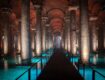
The Basilica Cistern Museum is one of the most significant cultural landmarks through which we can trace the grandeur of Istanbul’s historical legacy. Commissioned by Eastern Roman Emperor Justinian I (527–565), this vast underground cistern was dubbed the “Sunken Palace” by the public due to the countless marble columns rising from the water. In Latin, it is referred to as Cisterna Basilica, owing to its location beneath the former Stoa Basilica, hence also commonly known as the Basilica Cistern.
With a capacity to store 80,000 tons of water, it is the largest enclosed cistern in the city and stands out for its extensive use of spolia (reused architectural elements), more than any other structure of its kind. Covering an area of approximately 10,000 m², this monumental rectangular structure measures 140 meters in length and 70 meters in width.
According to historical sources, the cistern collected water via aqueducts and rainfall, distributing it to the Great Palace, where the emperors resided, as well as surrounding buildings. It was also supplied by the Hadrianus Aqueduct, one of the major ancient water channels.
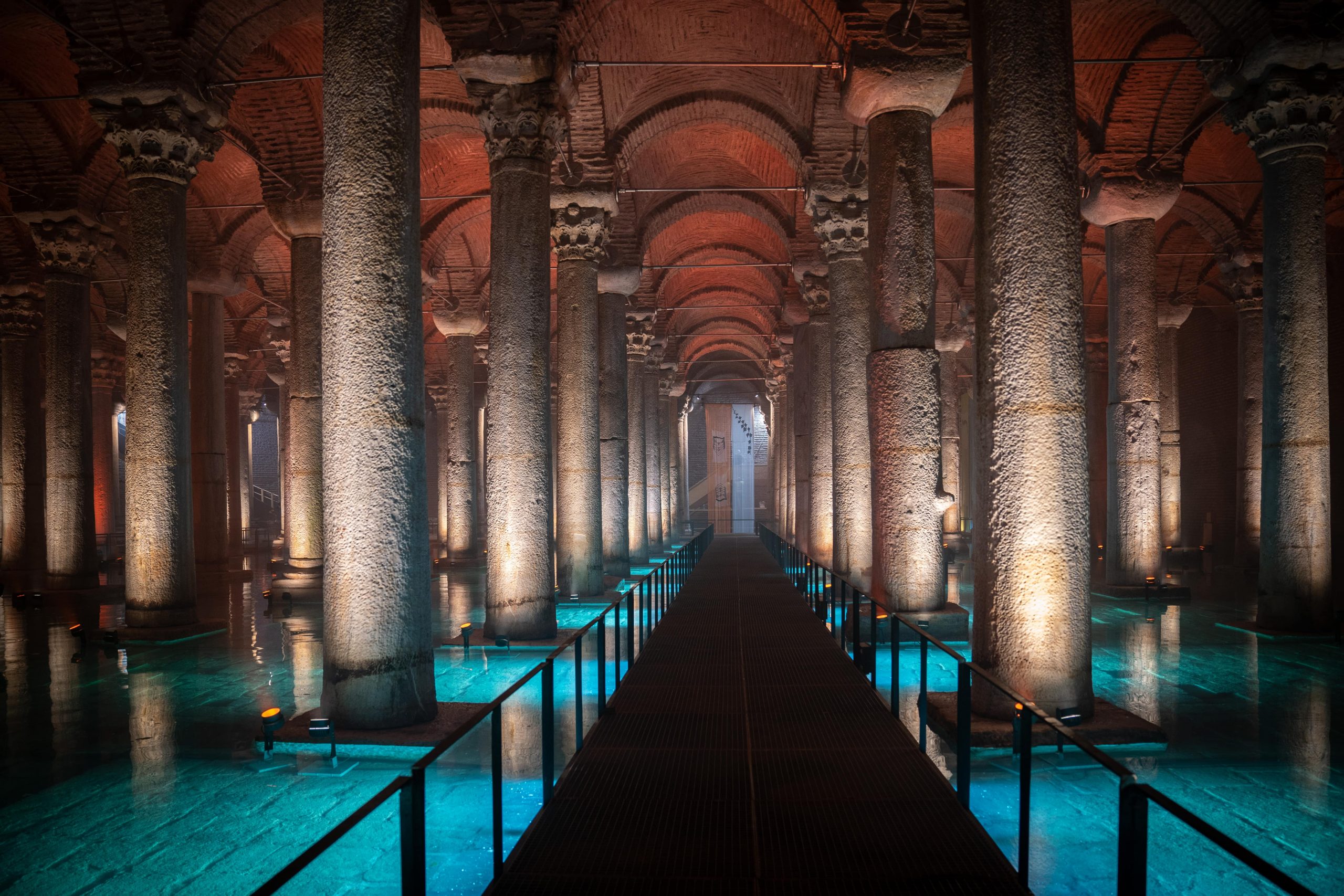
Inside the cistern are 336 columns, each 9 meters high. These columns are arranged in 12 rows of 28, spaced 4.80 meters apart. Carved from various types of marble, most of the columns are monolithic, while some are composed of two pieces.
The column capitals exhibit a range of styles—some feature elaborate Corinthian motifs, while others are plain and unadorned. Aside from a few fluted or angular examples, the majority of the columns are cylindrical.
The cistern’s 4.80-meter-thick brick walls and its brick-paved floor are coated with a thick layer of waterproof Horasan mortar to ensure water resistance.
Following the conquest of Istanbul in 1453, the cistern continued to be used for some time to meet the needs of the Topkapı Palace. As residential settlements gradually developed in the area, the cistern began to serve the local population as well.
Until the mid-16th century, the cistern remained largely unknown to Westerners. It was “rediscovered” during this period by French naturalist and topographer Petrus Gyllius, who lived in Istanbul between 1544 and 1555. Gyllius was the first to document the cistern’s dimensions, noting that it measured 336 feet in length and 182 feet in width, with a perimeter of 224 Roman paces. He also meticulously counted and recorded all 336 columns and observed numerous wells on the cistern’s roof.
In his writings, Gyllius remarked:
“People draw water using buckets; some even row boats inside the cistern, illuminating the space with lanterns while fishing. Light and air enter through the wells above, and fish swim beneath the beams of light.”
These observations confirm that the local residents were well aware of the cistern’s existence at the time.
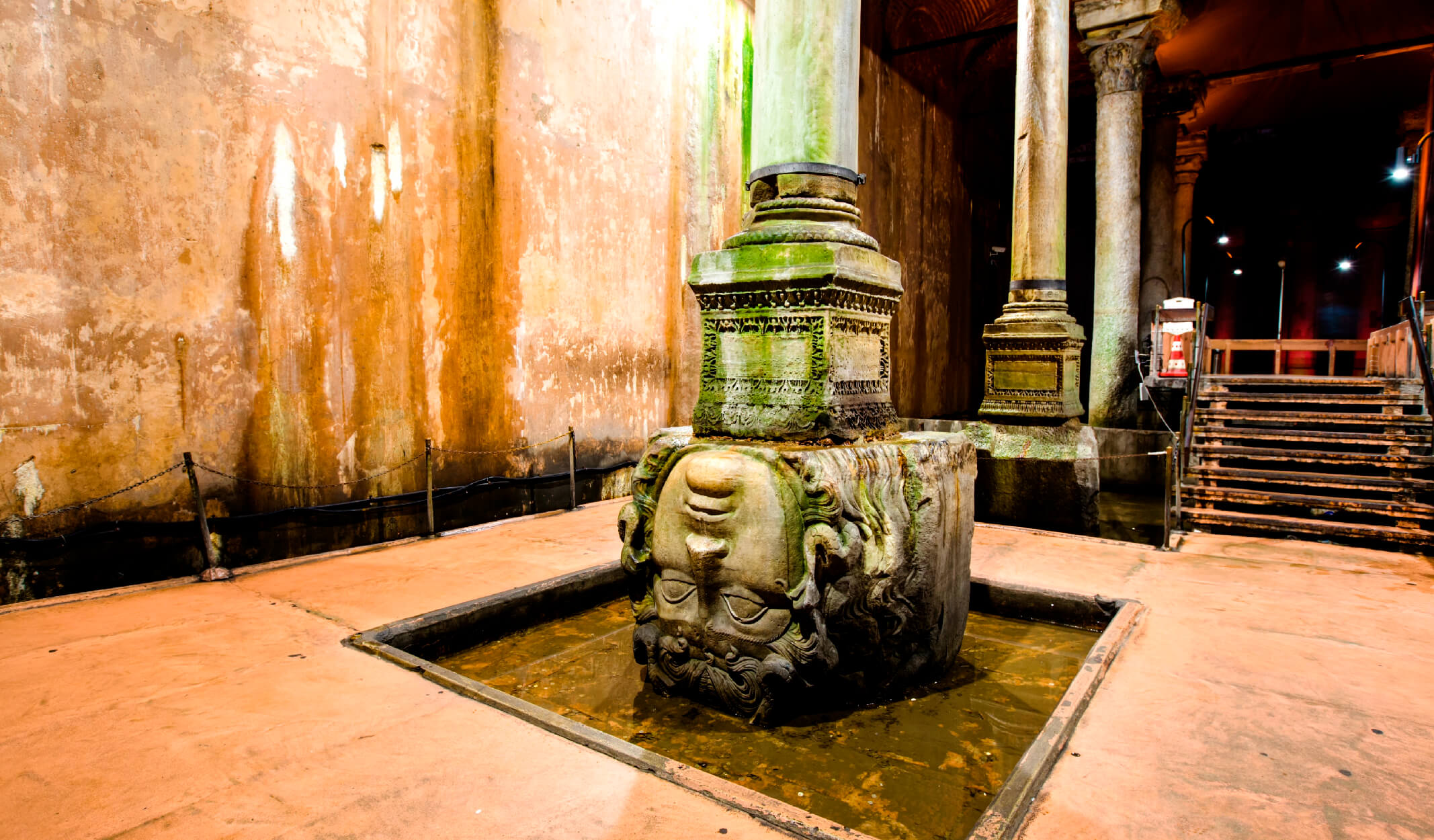
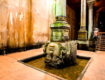
The Basilica Cistern underwent its first documented restoration during the reign of Sultan Ahmed III, led by the architect Kayserili Mehmet Ağa. A second restoration took place under Sultan Abdülhamid II. In later years, maintenance efforts continued. Between 1955 and 1960, nine structurally vulnerable columns were encased in thick concrete for stabilization. During the extensive cleaning and restoration works carried out by the Istanbul Metropolitan Municipality between 1985 and 1987, the cistern’s most iconic elements—the Medusa heads—were discovered.
These Medusa heads, used as column bases and located on the western and eastern ends of the cistern, are positioned upside-down and sideways, respectively. Renowned as some of the finest examples of Roman sculpture, the Medusa heads continue to captivate visitors and are surrounded by rich mythology:
According to one legend, Medusa was one of the three Gorgon sisters of the underworld in Greek mythology. She had the power to turn anyone who looked directly at her into stone.
Another tale tells of a beautiful maiden with long hair and dark eyes, who was loved by Perseus, the son of Zeus. Athena, also in love with Perseus and jealous of Medusa, transformed Medusa’s hair into snakes, cursing her so that anyone who met her gaze would be turned to stone. Perseus eventually decapitated Medusa and used her head as a weapon in his battles.
Following restoration, the Basilica Cistern was reopened to the public as a museum in 1987 with the installation of a visitor platform. Since then, it has hosted numerous national and international cultural events.
An essential stop on any tour of Istanbul, the cistern has welcomed many distinguished visitors over the years, including former U.S. President Bill Clinton, former Dutch Prime Minister Wim Kok, former Italian Foreign Minister Lamberto Dini, former Swedish Prime Minister Göran Persson, and former Austrian President Thomas Klestil.
Thanks to the most extensive restoration project in its history—undertaken by İBB Heritage—the Basilica Cistern Museum was reopened to the public on July 22, 2022. Today, it continues to host visitors with a contemporary museology approach. Under the management of Kültür AŞ, it also serves as a unique venue for temporary exhibitions, contemporary art installations, cultural performances, and musical events, creating a rich cultural space that bridges the past and the future.
Yerebatan Cad. Alemdar Mah. 1/3 34410 Sultanahmet-Fatih/İSTANBUL0 (212) 222 28 82info@yerebatan.comhttp://yerebatansarnici.com/